
Government Strategies Update
COVID-19 Stimulus: Substantial Changes to, Expansion of Main Street Lending Program for Small to Midsize U.S. Businesses
Today, the U.S. Board of Governors of the Federal Reserve System (Federal Reserve) announced substantial changes to and an expansion of its Main Street Lending Program authorized under the Coronavirus Aid, Relief and Economic Security (CARES) Act to provide financing to small and midsize businesses. Today’s announcement is in response to comments the Federal Reserve received from approximately 2,200 individuals, businesses and nonprofits, solicited when it initially announced the Main Street Lending Program. The Federal Reserve is seeking to provide a wider set of small and midsized businesses access to the financing.
Among other things, the Federal Reserve lowered the minimum loan size for certain loans to $500,000 (previously the minimum loan size was $1 million), raised the maximum loan size for certain loans, and for all loans expanded the eligibility to businesses with up to 15,000 employees or $5 billion in 2019 annual revenue (previously, eligibility was limited to businesses with up to 10,000 employees and $2.5 billion in 2019 annual revenue). The Federal Reserve also clarified many other important aspects of the program through revised term sheets and a set of FAQs. For the first time, the Federal Reserve also specifically excluded certain businesses from the program, namely those ineligible for Small Business Administration (SBA) loans, with some modifications (the first time the Main Street program has been linked to any SBA rules).
The changes apply to two previously established programs under the Main Street Lending Program: the Main Street New Loan Facility (MSNLF) and Main Street Expanded Loan Facility (MSELF).The Federal Reserve also added a new program: the Main Street Priority Loan Facility (MSPLF). Eligible businesses may participate in any of these three programs if they meet the eligibility criteria for the relevant program but may participate in only one of the three. In addition, eligible businesses may not receive assistance under the Primary Market Corporate Credit Facility (described in a previous Sidley update available here) or certain other types of financial assistance under Title IV of the CARES Act. Participants in these programs are still eligible for loans pursuant to the Paycheck Protection Program if they meet the applicable criteria.
Through these three programs, the Federal Reserve will continue to provide in total up to $600 billion in loans to small and midsize businesses through the Federal Reserve Bank of Boston’s $75 billion equity investment in a special purpose vehicle. It will also continue to apply the conditions and restrictions applicable to loans authorized under Section 4003(b)(4) of the CARES Act, including limits on compensation, stock buybacks and capital distributions, although it now allows certain tax distributions for certain pass-through entities. Sidley provided a summary of these conditions and restrictions, available here (under “Title IV Loan Programs Administered by the Federal Reserve”). Other conditions and restrictions apply to the Main Street loans.
In announcing the expansion, the Federal Reserve noted the critical role that nonprofit organizations play throughout the economy and stated that it is “evaluating a separate approach to meet their unique needs.” As such, the programs currently established under the Main Street Lending Program are not intended to support nonprofit organizations.
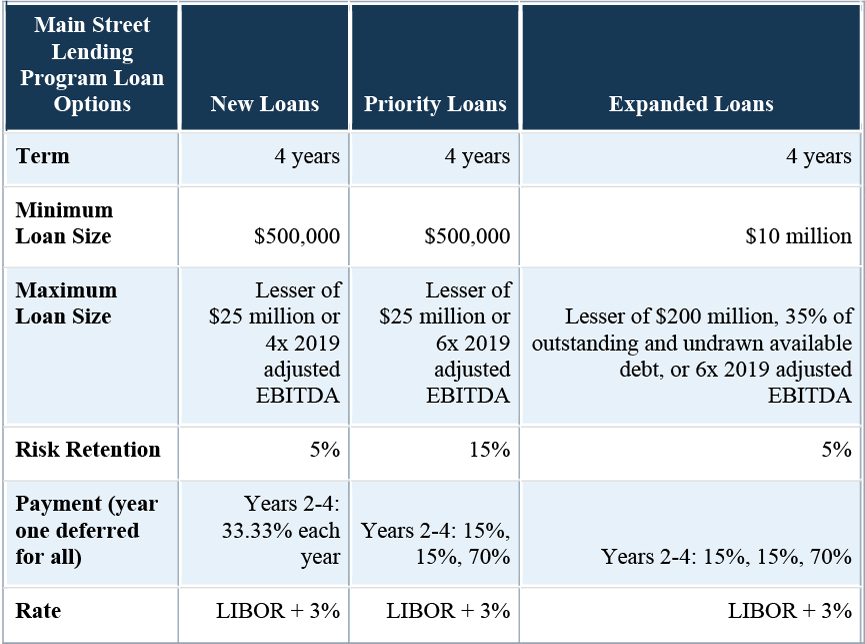
This update provides summaries of the two expanded programs and the new program, and highlights key points. These summaries are not complete descriptions of the terms and conditions for each program, so they should be read in conjunction with the term sheets, FAQs, and other information published by the Federal Reserve. We include links to the term sheets with each of the facilities below and at the end of the update a summary table of the three programs that was generated by the Federal Reserve in its press release.1 In addition, a copy of FAQs about the Main Street Lending Program created by the Federal Reserve is available here.
Main Street New Loan Facility
- The MSNLF will continue to provide new loans, and the Federal Reserve will continue to purchase a 95 percent participation in the loans, requiring the lender to hold the other 5 percent.
- The Federal Reserve has now expanded eligibility to businesses with up to 15,000 employees or up to $5 billion in annual revenues (based on the business’s 2019 reported revenue). The condition that the businesses be U.S.-organized and have significant operations and a majority of its employees in the United States still applies.
- The minimum loan under the MSNLF has been reduced from $1 million to $500,000. The maximum loan generally has not changed, although the Federal Reserve has clarified some aspects of how it is calculated. It continues to be the lesser of (i) $25 million or (ii) an amount, when added to the eligible business’s existing outstanding and committed but undrawn debt that does not exceed four times the eligible business’s 2019 earnings before interest, taxes, depreciation and amortization (EBITDA).
- The loans will have a four-year maturity with an interest rate equal to the adjustable rate of the London interbank offered rate (LIBOR) (one or three months) plus 300 basis points, with principal and interest payments deferred for one year. Each year thereafter requires a payment of 33.3 percent of the amortized principal.
- The Federal Reserve’s term sheet, which outlines the full details of the MSNLF, including the conditions and restrictions, is available here.
Main Street Expanded Loan Facility
- MSELF will continue to provide upsized tranches on existing loans first originated on or before April 24, 2020, with a remaining maturity of at least 18 months. The eligible loans have been expanded to include revolving loans in addition to term loans. The Federal Reserve will continue to purchase a 95 percent participation in the upsized tranche and will require the lender to hold the other 5 percent.
- Eligibility has been expanded to businesses with up to 15,000 employees or up to $5 billion in annual revenues (based on the business’s 2019 reported revenue). As with MSNLF, the Federal Reserve still requires that the businesses be U.S.-organized and have significant operations and have a majority of its employees in the United States.
- The minimum loan under the MSELF has been increased from $1 million to $10 million. Moreover, the maximum upsized tranche loan has also increased to the lesser of (i) $200 million, (ii) 35 percent of the eligible business’s existing outstanding and committed but undrawn bank debt or (iii) an amount that, when added to the eligible business’s existing outstanding and committed but undrawn debt, does not exceed six times the eligible business’s 2019 EBITDA. Previously, the maximum upsized tranche loan under MSELF was the lesser of (i) $150 million, (ii) 30 percent of the eligible business’s existing outstanding and committed but undrawn bank debt or (iii) an amount that, when added to the eligible business’s existing outstanding and committed but undrawn debt, does not exceed six times the eligible business’s 2019 EBITDA. The Federal Reserve has also clarified how certain aspects of these calculations should be performed.
- The upsized tranche loans will have a four-year maturity with an interest rate equal to the adjustable rate of LIBOR (one or three months) plus 300 basis points, with principal and interest payments deferred for one year. The second and third years thereafter require a payment of 15 percent of the amortized principal, and the fourth year requires a payment of 70 percent of the amortized principal.
- The Federal Reserve’s term sheet, which outlines the full details of the MSELF, including the conditions and restrictions, is available here.
Main Street Priority Loan Facility
- The expansion of the Main Street Lending Program includes the addition of the MSPLF, which provides for a higher ceiling for risk as compared with the MSNLF. To account for the increased risk, the Federal Reserve will purchase an 85 percent participation in the loan and will require the lender to hold the other 15 percent. The MSPLF also allows eligible borrowers to refinance certain debt, unlike the MSELF or MSNLF.
- Similar to the MSNLF, the MSPLF will provide new loans to eligible businesses with up to 15,000 employees or up to $5 billion in annual revenues (based on the business’s 2019 reported revenue), and the minimum loan size will be $500,000. The maximum loan size, however, will be the lesser of (i) $25 million or (ii) an amount, when added to the eligible business’s existing outstanding and committed but undrawn debt, that does not exceed six times the eligible business’s 2019 EBITDA. The Federal Reserve clarified certain aspects of how this calculation should be performed.
- The loans will have a four-year maturity with an interest rate equal to the adjustable rate of LIBOR (one or three months) plus 300 basis points, with principal and interest payments deferred for one year. The second and third years thereafter require a payment of 15 percent of the amortized principal, and the fourth year requires a payment of 70 percent of the amortized principal.
- The Federal Reserve’s term sheet, which outlines the full details of the MSPLF, including the conditions and restrictions, is available here.
1 https://.www.federalreserve.gov/newsevents/pressreleases/monetary20200430a.htm
弁護士広告—Sidley Austin LLP はグローバルな法律事務所です。当事務所の所在地および連絡先情報は、www.sidley.com/en/locations/offices に掲載されています。
Sidley は、本情報をクライアントおよび関係者の皆様へのサービスとして、教育目的のみに提供しています。本情報は、法的助言として解釈または依拠されるべきものではなく、また弁護士と依頼者の関係を生じさせるものでもありません。読者は、専門家の助言を求めることなく本情報に基づいて行動すべきではありません。Sidley および Sidley Austin とは、www.sidley.com/disclaimer に記載のとおり、Sidley Austin LLP およびその関連パートナーシップを指します。
© Sidley Austin LLP
お問い合わせ
この Sidley Update に関してご質問がある場合は、通常ご担当されている Sidley の弁護士、またはご連絡ください。


ません Related Resources ません
得意分野
Suggested News & Insights
- Stay Up To DateSubscribe to Sidley Publications
- Follow Sidley on Social MediaSocial Media Directory