
Corporate Governance Update
BlackRock Releases 2020 Engagement Priorities with a Focus on Sustainability and ISS Issues New Climate Voting Policy
Just at the cusp of the proxy season, BlackRock has released five engagement priorities for 2020 and identified related key performance indicators (KPIs) that it expects companies to address in corporate disclosures – presumably proxy statements. Also, Institutional Shareholder Services (ISS) has published a new Climate Voting Policy for investors looking to tailor their engagement practices and/or reconsider their voting decisions based on climate-related practices and disclosures.
These releases from BlackRock and ISS serve to remind public companies that, even while navigating the uncharted COVID-19 waters, attention to shareholder concerns and effective shareholder engagement continues to be important.
BlackRock’s Engagement Priorities and Corresponding KPIs
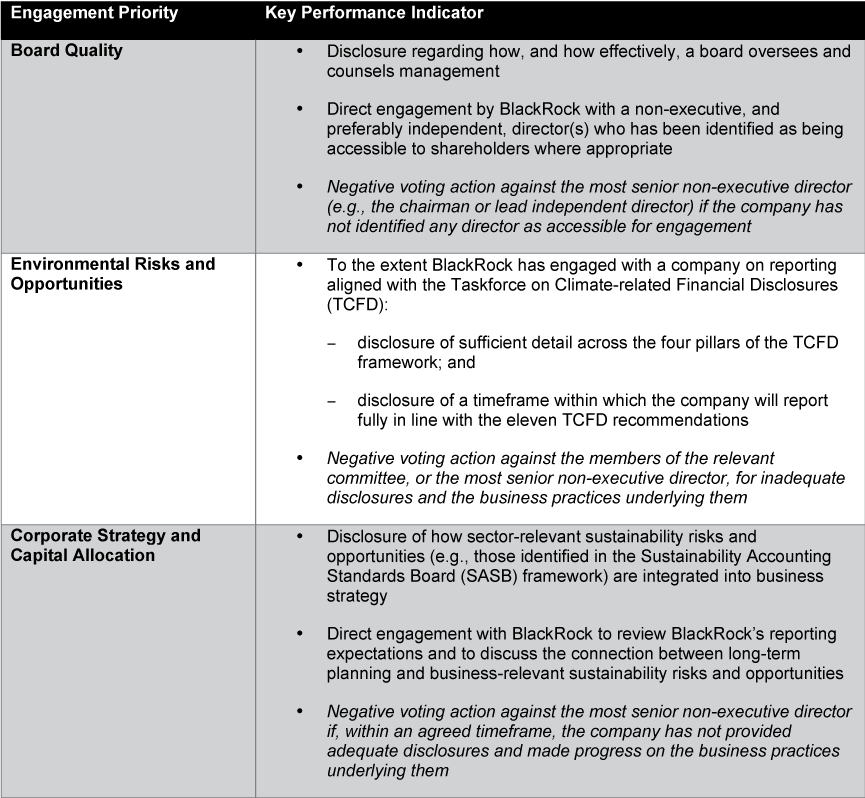
BlackRock will base certain voting decisions, often vote decisions regarding the election of the non-executive chairman or lead director, on a company’s performance against the newly-prescribed KPIs in the areas of:
- board quality
- environmental risks and opportunities
- corporate strategy and capital allocation
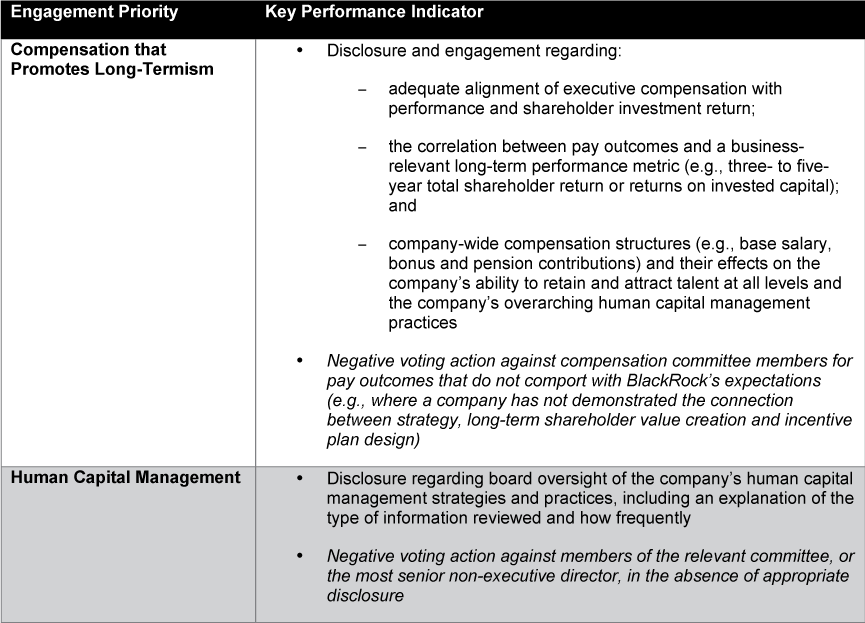
- compensation that promotes long-termism, and
- human capital management.
These priorities resolutely underscore BlackRock’s focus on sustainability efforts. Public companies, and particularly those that list BlackRock among their largest shareholders, should review the new priorities and related KPIs and consider how their underlying practices and related public disclosures compare and how voting may be impacted. They should also consider whether additional disclosures can be made at this stage in the proxy season.
The table below summarizes BlackRock’s new KPIs within each engagement priority and the voting actions BlackRock may take. Companies should review these KPIs and consider them in the context of their broader shareholder engagement strategy, with BlackRock and others, for the 2020 proxy season, and to the extent still possible consider how to address in the proxy statement.
ISS’s New Climate Voting Policy
ISS will also base certain voting decisions on climate-related issues – decisions regarding climate-related shareholder proposals and decisions regarding directors who are considered by ISS to be abdicating their responsibility to appropriately address climate-related risks and/or adequately report sustainability metrics. ISS will use the following factors to evaluate, on an industry-specific basis, a company’s climate-related performance:
- climate norms violations,
- disclosure indicators,
- current performance indicators (including greenhouse gas emissions data),
- future performance indicators drawing from the ISS Carbon Risk Classification, and
- the ISS Carbon Risk Classification.
ISS will use its assessment not only to make vote recommendations but also to provide Climate Awareness Scorecards to institutional investors. Again, public companies should review this new Climate Voting Policy as a yardstick to assess potential impacts on vote outcomes and consider the feasibility of revising their proxy materials to add responsive disclosure.
Additional Resources
Note that Sidley has organized a multidisciplinary task force to address the wide range of regulatory, transactional and litigation issues companies face in responding to COVID-19. For more information, and for additional COVID-19 updates, please visit our Resource Center.
律师广告—Sidley Austin LLP 是一家全球性律师事务所。我们的地址及联系方式可在 www.sidley.com/en/locations/offices 查阅。
Sidley 提供本信息仅作为向客户及其他友好人士提供的服务,且仅供教育目的使用。本信息不应被解释或依赖为法律意见,亦不构成律师与客户关系。读者在未寻求专业顾问意见之前,不应依据本信息采取任何行动。Sidley 和 Sidley Austin 指 Sidley Austin LLP 及其关联合伙实体,详见 www.sidley.com/disclaimer。
© Sidley Austin LLP
联系我们
如果您对本次 Sidley 更新有任何疑问,请联系您平时合作的 Sidley 律师,或




Capabilities
Suggested News & Insights
- Stay Up To DateSubscribe to Sidley Publications
- Follow Sidley on Social MediaSocial Media Directory